The authority audit: 5 Best Practices to build accountability in Facility Management
Clarity in FM authority is crucial. 5 Best Practices build accountability: map decision rights, empower supervisors, enable cross-functional escalation, and audit gaps.

I've watched facility management teams collapse under their own confusion.
The technicians were skilled. The budget was adequate. The software was installed.
But when a critical system failed, nobody knew who had the authority to approve the emergency repair. Three managers debated. Two vendors waited. One building tenant called corporate to complain.
The problem wasn't capability. It was clarity.
Why authority structures matter more than you think
When roles blur in facility management, the damage compounds quickly.
Decision delays stack up. Service providers sense that deadlines are negotiable. Technical problems accumulate. User satisfaction drops. Eventually, you lose clients or damage your reputation.
Research shows that employees in ambiguous roles are 1.5 times more likely to leave. Role confusion doesn't just slow work down. It drives your best people out.
The organizations that win at facility management share one trait: crystal clear authority structures where every decision has an owner and every owner has accountability.
Five best practices for building clear authority
1. Map decision rights, not just job titles
Job descriptions tell you what someone does. Decision rights tell you what they can approve.
Create a simple matrix:
- Who can approve emergency spending? (and up to what amount)
- Who assigns tasks to contractors?
- Who validates completed work?
- Who communicates with end users?
When you document decision authority, you eliminate the delays that kill momentum.
2. Give your FM supervisor three superpowers
True accountability requires visibility, awareness, and control.
Your FM supervisor needs:
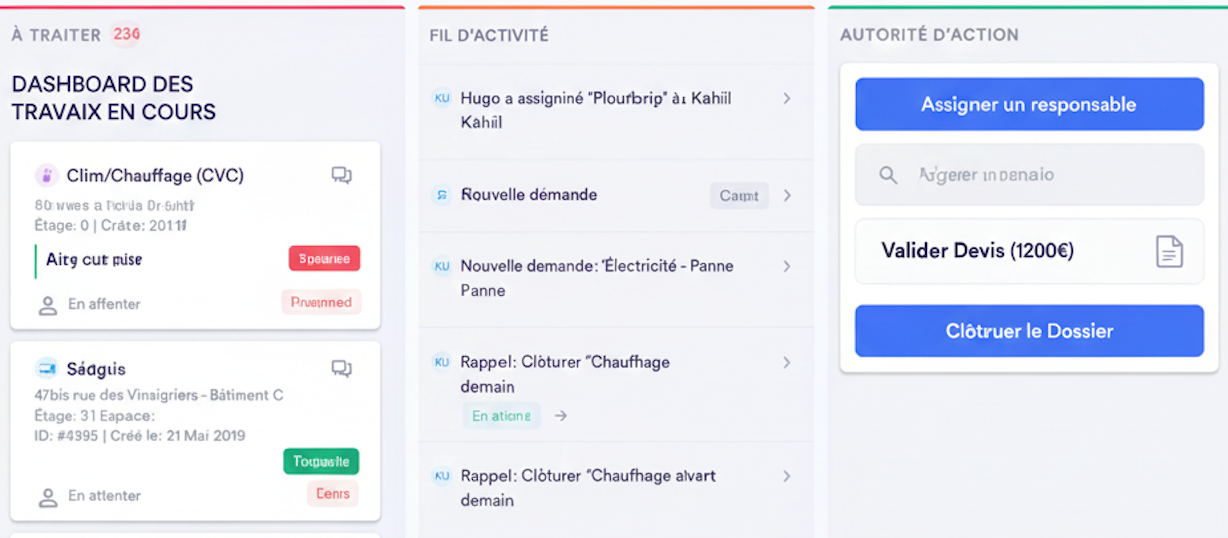
- A dashboard showing all active work across teams
- An activity feed with reminders and notifications
- The authority to act: assign work, validate quotes, close jobs
This isn't about micromanagement. It's about giving one person the tools to orchestrate workload, set priorities, and design new processes when needed.
3. Enable cross-functional job escalation
Accountability breaks down at the handoffs.
A cleaner spots a security issue but has no way to flag it. A maintenance tech notices a safety hazard but doesn't know who handles those requests.
Build the layer that smooths communication between silos.
Any team member should be able to raise a job for another service line. Your system should route it automatically. Your end users should have one point of contact who ensures things move without delays.
4. Track accountability metrics, not just activity
Most FM teams measure inputs: cost per square foot, number of work orders opened. Measure outcomes instead:
- Tasks completed on time
- Average response time
- User satisfaction scores
- Jobs closed before due date
When you track whether work actually gets done well and on time, accountability becomes visible.
Check your dashboard weekly. If you see unassigned jobs piling up or treatment delays climbing, you've spotted your bottleneck before it becomes a crisis.
5. Audit your authority gaps
You can't fix what you can't see. Run this diagnostic:
- Ask your workers: What makes you accountable for your work? What failed recently and why?
- Ask your end users: What does good service look like to you? (Ask multiple people, not just one.)
- Audit your tools: What technology is actually being used? Cut underutilized tools and see if anyone complains.
The gaps you discover will show you exactly where authority is unclear and accountability is missing.
Authority drives everything else
You can have the best maintenance plan, the most advanced software, and the most skilled technicians.
But if nobody knows who owns what, work stalls.
Clear authority structures are the foundation. They enable strategic planning, effective resource allocation, and integrated operations.
When you define decision rights, empower your supervisors, enable cross-functional escalation, measure accountability, and audit your gaps, you transform confusion into clarity.
Your team stops debating and starts delivering.