Property Manager vs. Facility Manager: What's the Real Difference?
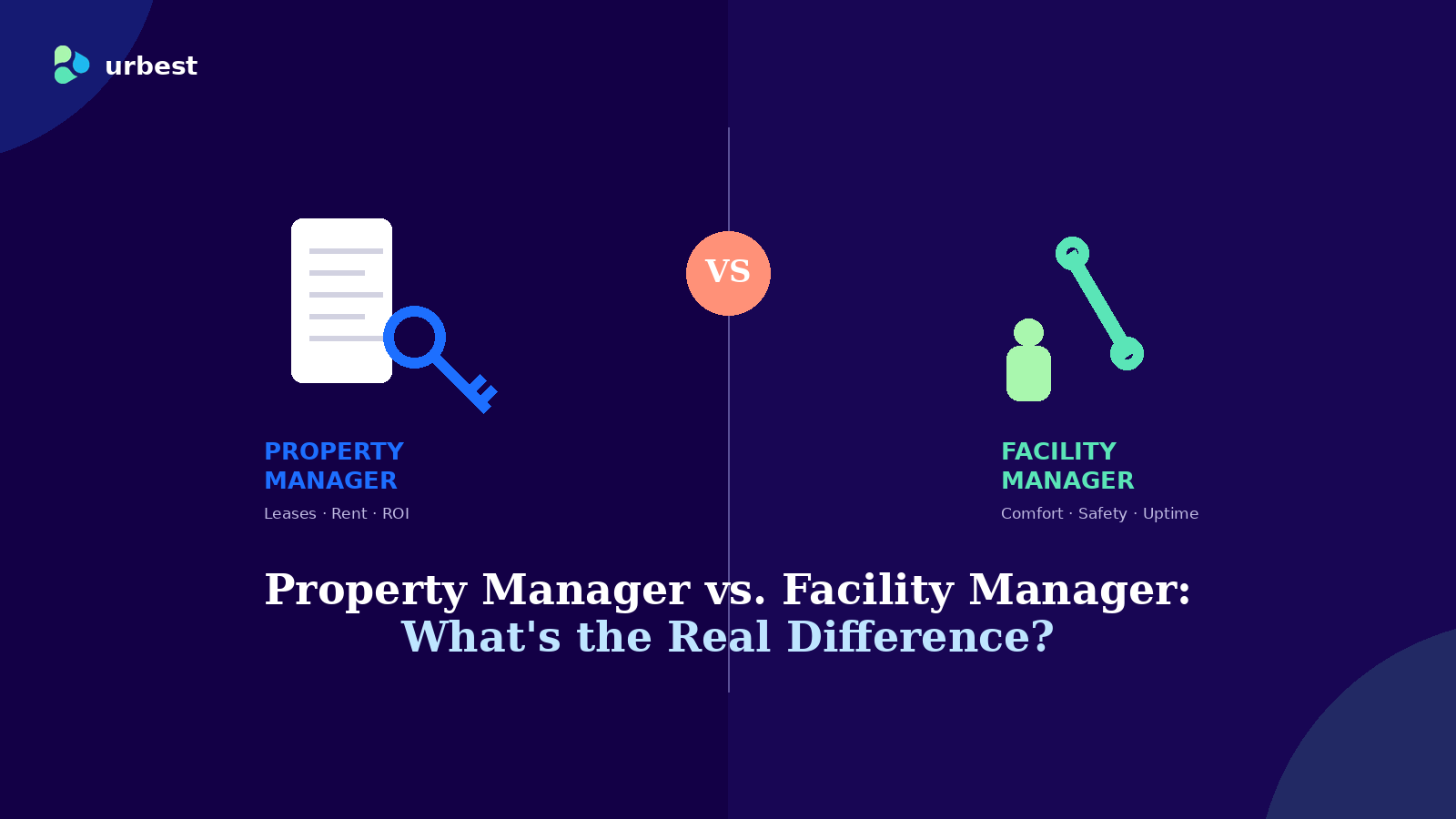
If you've ever sat in a meeting where someone asked "shouldn't the property manager handle this?" only for someone else to reply "no, that's facilities" you already know how blurry these two roles can feel from the outside.
The confusion is understandable. Both roles exist to make a building work. Both deal with tenants, contractors, budgets, and the occasional 8 a.m. emergency call. On a small site, the same person might even wear both hats. But the moment an organization grows past a certain size, the distinction stops being academic it starts affecting who gets called when something breaks, who signs off on a budget, and who tenants actually trust to fix their problem.
Here's the difference, without the jargon.
Two different jobs, one shared goal
A property manager works primarily for the owner or investor. Their world revolves around the asset as a financial instrument: rent collection, lease renewals, tenant screening, vacancy rates, compliance with local regulations, and ultimately the return the property generates. If a building underperforms financially, the property manager is usually the first to know, and often the first expected to explain why.
A facility manager works primarily for the people inside the building. Their world revolves around the asset as a working environment: HVAC systems, safety compliance, cleaning contracts, space planning, and the hundred small things that determine whether an office, a hospital, or a school actually functions day to day. If the air conditioning fails on a July afternoon, the facility manager is the one fielding the calls not because it's glamorous, but because someone has to be.
Put simply: property management is about the building as an asset. Facility management is about the building as an experience.
Where the lines blur and why that's normal
In practice, almost no organization draws a perfectly clean line between the two. A property manager overseeing a major renovation will inevitably touch facilities-related decisions. A facility manager negotiating a maintenance contract will inevitably touch budget lines that matter to the property manager's numbers.
This overlap isn't a sign that something is broken. It's simply what happens when two roles are responsible for the same physical space from different angles — one focused on value, the other on function. The organizations that struggle aren't the ones with overlap; they're the ones where nobody has bothered to clarify who owns what when a decision falls in the grey zone.
A quick way to tell them apart
If you're trying to figure out which role you're dealing with or which one you actually need to hire a simple test helps: who signs the check, and who answers the phone?
- If the question is "can we afford this, and does it protect the owner's investment?" that's property management territory.
- If the question is "who's going to actually get this fixed, and how fast?" that's facility management territory.
Most day-to-day requests from tenants or employees — a flickering light, a broken door, a request for extra cleaning land squarely on the facility side. Most strategic, financial, or contractual questions lease terms, insurance, capital improvements land on the property side.
Why getting this right matters more than it seems
When the split between these roles is unclear, three things tend to happen, in roughly this order:
Requests get lost in translation. A tenant reports a maintenance issue to whoever they think is "in charge," and if that's the wrong person, the request either stalls or gets forwarded manually often by email, often more than once.
Accountability becomes fuzzy. When a recurring problem isn't clearly assigned to one role, it tends to get addressed reactively rather than prevented because no one owns the pattern, only the individual incidents.
Trust erodes, quietly. Tenants and employees don't usually care about the org chart. They care about whether the building responds when something's wrong. Every time a request falls into a grey zone and takes longer to resolve, that trust takes a small hit — one that's hard to measure and easy to underestimate.
None of this requires a reorganization to fix. It usually just requires visibility: a shared, structured way for both roles to see what's happening across the building, without needing to be the one who personally handles every request.
The bottom line
Property managers and facility managers aren't competing for the same job, they're covering two different dimensions of the same building. One protects its value. The other protects the experience of the people inside it. The best-run properties aren't the ones where a single person does both they're the ones where both roles have clear visibility into what the other is doing, so nothing falls through the cracks between "the asset" and "the people using it."
Urbest helps property managers, facility managers, service providers, and occupants stay on the same page literally. If you're curious how a shared, structured view of building operations can reduce the grey zones between these roles, take a look at how it works.
#PropertyManagement #FacilityManagement #PropertyManager #FacilityManager #RealEstate #BuildingManagement #CRE #WorkplaceManagement #AssetManagement #TenantExperience #PropTech #FacilitiesManagement#en#urbest