Who Does What in a Household? A professional guide to avoiding domestic Conflicts
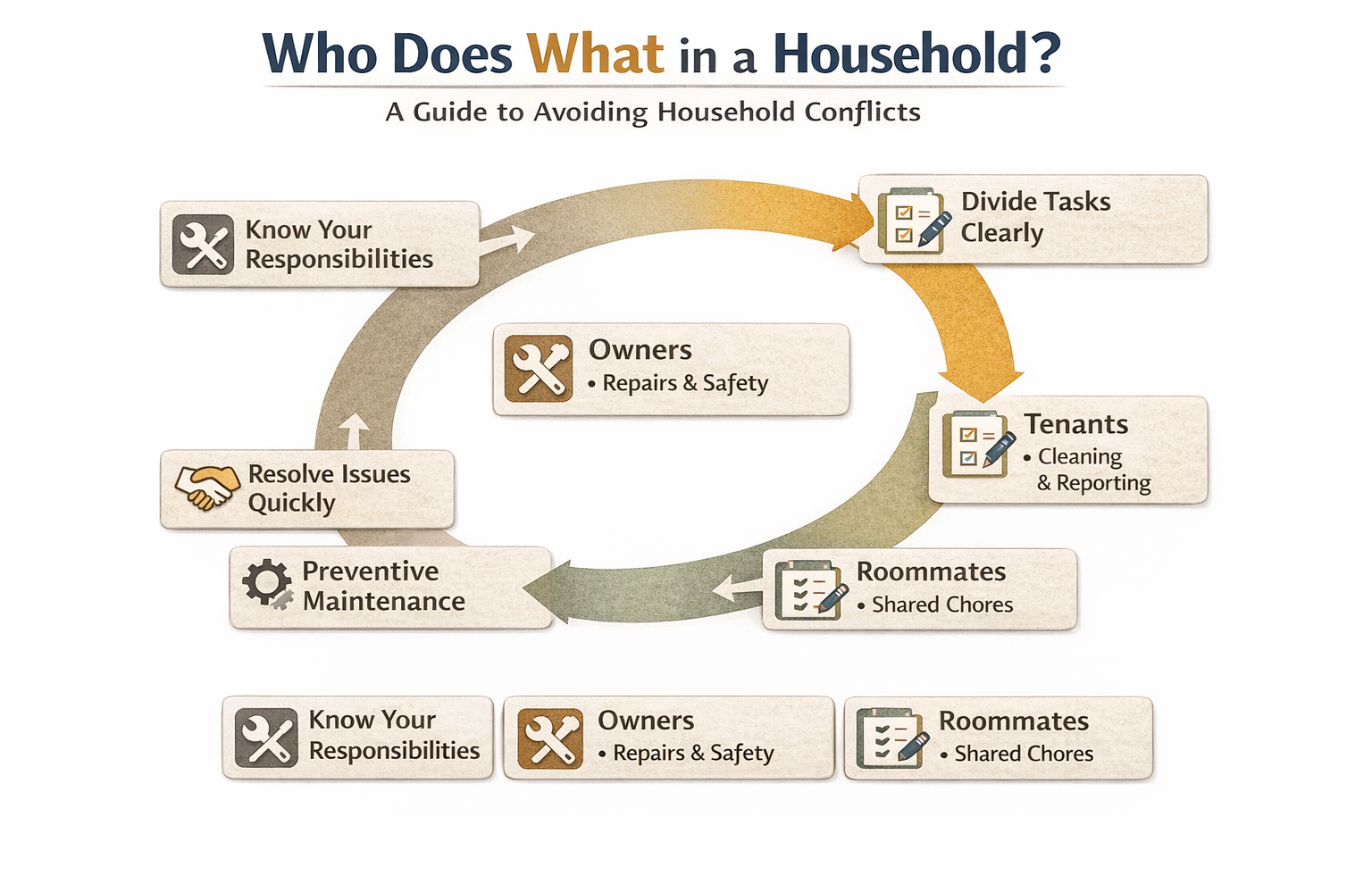
Household conflicts rarely start with major issues, they usually begin with unwashed dishes, unmowed lawns, and unclear expectations about who handles what.
The difference between a smoothly running household and one plagued by disputes comes down to one thing: a clear system for allocating responsibilities from day one.
Whether you manage a rental property, share an apartment with roommates, or coordinate between owners and tenants, applying professional facility management principles to household responsibilities eliminates ambiguity and prevents conflicts before they arise.
Understanding Legal vs. Practical Responsibilities
Every household operates within two frameworks: legal obligations and practical necessities.
Property owners carry specific legal responsibilities that cannot be delegated to tenants, including:
- Structural repairs
- Major system maintenance (heating, plumbing, electrical)
- Ensuring the property meets safety standards
For more guidance on landlord obligations in English-speaking countries, see Nolo’s Landlord Responsibilities Guide and HG.org: Landlord Tenant Law.
Tenants are responsible for maintaining the property in good condition during occupancy:
- Routine cleaning
- Minor repairs from normal use
- Promptly reporting maintenance issues
Ignoring small problems can lead to disputes and expensive damages. The gray area between legal and practical responsibilities is where most household conflicts arise.
Building Your Responsibility Allocation System
Professional property managers prevent disputes by creating responsibility matrices: documenting every task, assigning clear ownership, and setting escalation procedures.
Step 1: Create a Complete Task Inventory
Organize tasks by frequency:
Daily tasks:
- Washing dishes and cleaning the kitchen
- Taking out the trash
- Tidying common areas
- Pet care responsibilities
Weekly tasks:
- Bathroom cleaning
- Vacuuming and floor care
- Laundry management
- Refrigerator maintenance
Monthly tasks:
- Deep cleaning appliances
- Filter replacements (HVAC, water)
- Window cleaning
- Outdoor area maintenance
Seasonal tasks:
- Gutter cleaning
- HVAC servicing
- Exterior maintenance
- Garden preparation
Creating this inventory reveals tasks that everyone assumes someone else handles.
Step 2: Assign Clear Ownership
- One person = one task
- In landlord-tenant relationships, document responsibilities in the lease agreement or a maintenance addendum.
- In shared living situations, create a written agreement signed by everyone.
Criteria for assigning tasks:
- Skill and access to tools
- Availability
- Balance of workload
For roommate responsibility templates, see Roommates.com Tips or Apartment Therapy Chore Guide.
Step 3: Implement a Tracking System
Digital tools:
- Shared calendar apps with task assignments
- Household management apps (like Urbest )
- Spreadsheets accessible to all parties
- Project management tools adapted for home use
Analog tools:
- Printed responsibility charts
- Weekly planning boards
- Task cards moving from “To-Do” to “Done”
Consistency is key choose a system everyone will actually use.
Preventive Maintenance: The Professional Approach
Commercial facilities prevent 70% of emergencies through scheduled preventive maintenance. Your household can too:
- HVAC systems: Change filters monthly, service twice yearly
- Plumbing: Inspect under sinks quarterly, check toilets
- Appliances: Clean refrigerator coils, descale water heaters
- Structural elements: Check weather stripping, caulking, and roof condition
Conflict Resolution
Even with clear systems, disputes arise. Establish escalation procedures:
- Direct communication: Address issues within 48 hours
- Documented discussion: Schedule formal discussion and write outcomes
- Third-party review: Involve property management, legal counsel, or a neutral mediator
Common dispute scenarios:
- “That’s not my responsibility” → Refer to your written agreement
- “I didn’t know it needed to be done” → Training gap; do a walkthrough
- “I don’t have time” → Reallocate tasks to balance workload
- “The standard is too high/low” → Define measurable standards
Special Considerations for Different Living Arrangements
- Multi-tenant properties: Separate responsibility matrices for private vs shared spaces
- Properties with caretakers: Define scope and communication protocols clearly
- Vacation or seasonal properties: Use checklists for opening/closing and schedule preventive maintenance off-season
Measuring Success
Track Key Performance Indicators (KPIs):
- Task completion rate: Target >95%
- Emergency repair frequency: Should decrease over time
- Dispute frequency: Aim for near zero
- Maintenance cost trends: Should stabilize or decrease
Review quarterly and adjust as needed.
Long-Term Value of Systematic Management
Households that implement professional responsibility management systems report:
- Fewer conflicts
- Lower maintenance costs
- Better relationships among occupants
Investing time upfront pays off daily. Eliminate ambiguity, prevent emergencies, and create accountability.
Your household deserves the same systematic approach that keeps commercial facilities running smoothly.
#HouseholdManagement #PropertyManagement #RoommateTips #PreventiveMaintenance #HomeOrganization #RentalTips #ConflictResolution #FacilityManagement #TaskManagement #ProTips